
GUIDE · jilino1
Gems Bonanza: when a whole-grid clear follows the tumbles
In the published description of Gems Bonanza, the Nuclear feature replaces the whole grid after the winning spins and tumbles have finished. A board changing all at once therefore needs to be identified as an event before it is treated as another win.
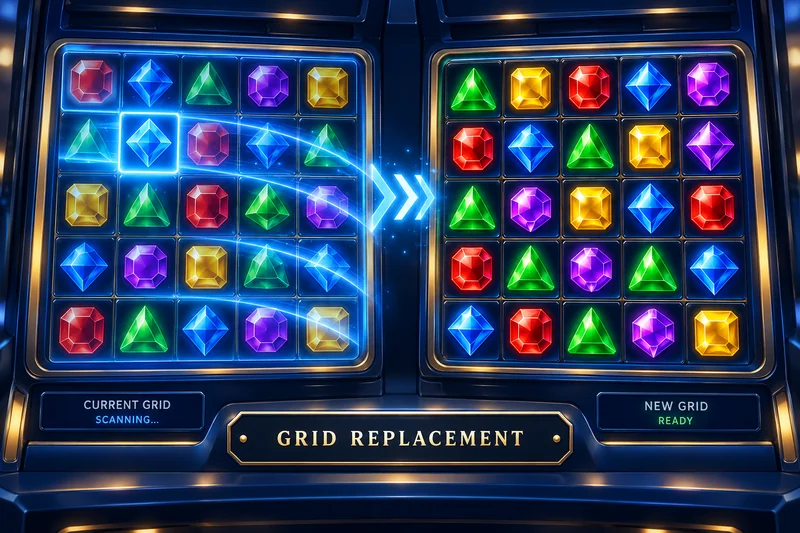
The useful detail is the order
Pragmatic Play’s 28 October 2020 announcement describes winning clusters followed by tumbling replacements. It separately places the blue-mark Nuclear effect after the winning sequence and says it generates an entirely new grid. We checked that historical description on 8 October 2026; it is not a direct inspection of a current account’s game build.
Two movements can look similar at speed: symbols disappear and others take their place. The reason for the movement matters. One may follow a qualifying group; another may be a modifier that changes the board. The disappearance itself does not tell you which happened.
Separate the event from the award
Use the following reading sequence for a hypothetical replay. It is a way to annotate the description, not a claim that a particular round occurred.
| Point in the sequence | What to record | What remains to be checked |
|---|---|---|
| A group is evaluated | The qualifying group and any stated award | The correct paytable and scope |
| Winning symbols are replaced | A tumble in the same sequence | Whether the resulting board produces another qualifying group |
| The winning sequence finishes | The end of ordinary winning tumbles | Any pending modifier described by the rules |
| The whole grid is replaced | The replacement event | The result of evaluating the new grid |
Do not enter a cash award simply because every position was cleared. The replacement explains how a new board appears; the award record must explain what that new board actually earned, if anything. Likewise, do not erase an earlier confirmed award merely because its symbols are no longer visible.
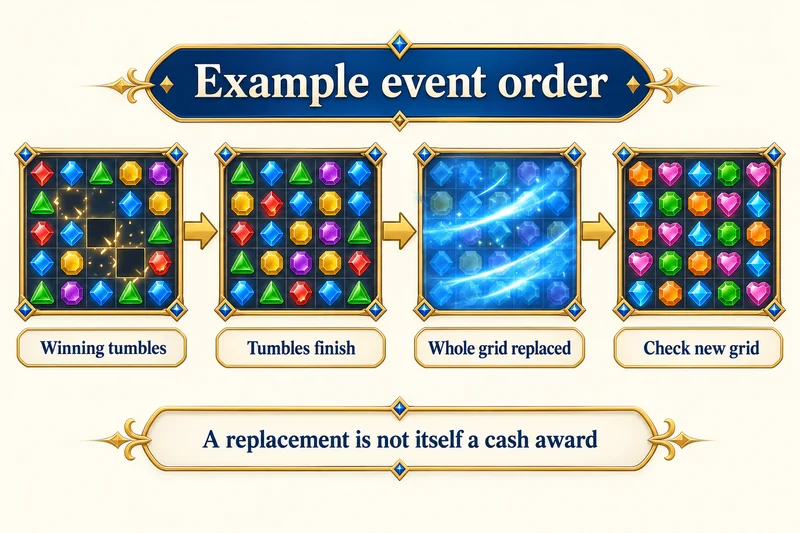
Why the last still image is often insufficient
Suppose a screenshot shows a full board of fresh gems. It does not reveal whether those gems arrived through several partial tumbles or one full replacement. A second screenshot might show a blue effect, but still omit the end of the winning sequence. The missing evidence is timing, not another count of the visible gems.
A useful note would read: “Winning tumbles ended; a whole-grid replacement followed; the next evaluation is not visible.” That description preserves what is known without silently turning the final screen into a paid result. If a history entry labels a feature, keep that label with the round reference and distinguish it from your own description.
Connectivity is a different question
Once the new board is present, you may still need to decide whether matching symbols form a connected group. The cluster adjacency and bridge example addresses that issue. A group’s shape does not explain why the entire screen was replaced, and a replacement does not establish that a new group qualifies.
If the help for the exact edition describes a different order, save that version and use it to frame the question. The historical announcement supports a narrow explanation of sequencing; it does not resolve every modifier interaction or certify a payout. More reading is available in the slot rules section and the topic collection on the jilino 1 homepage.
Source-based editorial research and original examples. Sources checked 2026-10-08.