
Senate Bill 2347: what a total ban on gambling ads would change in the Philippines

Short answer — Senator Francis “Chiz” Escudero has filed Senate Bill 2347, which would ban gambling advertising and sponsorships on television, radio, print, online and social media, including celebrity and influencer endorsements. As reported by The Philippine Star on 2 August 2026, the bill gives operators a one-year transition and sets fines of up to ₱200,000, ₱300,000 and ₱500,000 for a first, second and third offence, with prison terms of up to one, two and three years. It is a bill, not a law: it still has to pass both chambers of Congress. We could not open the Senate’s own bill page on 22 October 2026, so its current committee status is unverified.
For anyone who plays on licensed Philippine platforms, the practical question is what would disappear from your feeds and screens, what would stay, and how the proposed penalties compare with the tobacco advertising ban the bill is modelled on. That comparison, with our own peso calculations, is the core of this guide.
What does SB 2347 propose?
According to the Philstar report, the bill “aims to ban gambling promotions across television, radio, print, online and social media platforms”, “completely barring celebrity endorsements and influencer campaigns”. Escudero is quoted as saying: “It’s about time that we regulate the gambling industry the same way we regulated tobacco two decades ago.”
A separate report by SunStar, published 2 August 2026, adds the details of the penalty ladder and notes that business permits and operating licences could be revoked, that liable corporate officers may be penalised, and that foreign nationals could face deportation. Both outlets say the bill would also mandate a government-led education campaign on responsible gambling and mental-health support.
The main provisions, as reported
| Provision | What the reports say | Reported by |
|---|---|---|
| Scope | Gambling ads and promotions on TV, radio, print, online and social media | Philstar, SunStar |
| Endorsements | Celebrity and influencer endorsements barred; sponsorships banned | Philstar, SunStar |
| Transition | One year after enactment to remove existing materials | Philstar, SunStar |
| Penalties | Up to ₱200,000 / 1 year; ₱300,000 / 2 years; ₱500,000 / 3 years and licence revocation | Philstar, SunStar |
| Foreign nationals | Deportation of liable foreigners | Philstar, SunStar |
| Education | Government campaign on responsible gambling and mental health | Philstar, SunStar |
Philstar also reports that the bill seeks to put into law a recent voluntary circular by the Ad Standards Council that bans gambling imagery, so that the rule sits “under a national legal framework”. We have not read that circular ourselves.
How do the penalties compare with the tobacco ad ban?
Because Escudero explicitly points to tobacco, the obvious benchmark is Republic Act 9211, the Tobacco Regulation Act of 2003. Its Section 22 phased out tobacco advertising in steps: TV, cable and radio from 1 January 2007, cinema and outdoor from 1 July 2007, and all mass media from 1 July 2008, except inside point-of-sale premises. Section 32(c), which covers violations of the advertising and promotion provisions, sets fines of not more than ₱100,000, then ₱200,000, then not more than ₱400,000, with prison terms of up to one, two and three years and revocation of permits on the third offence.
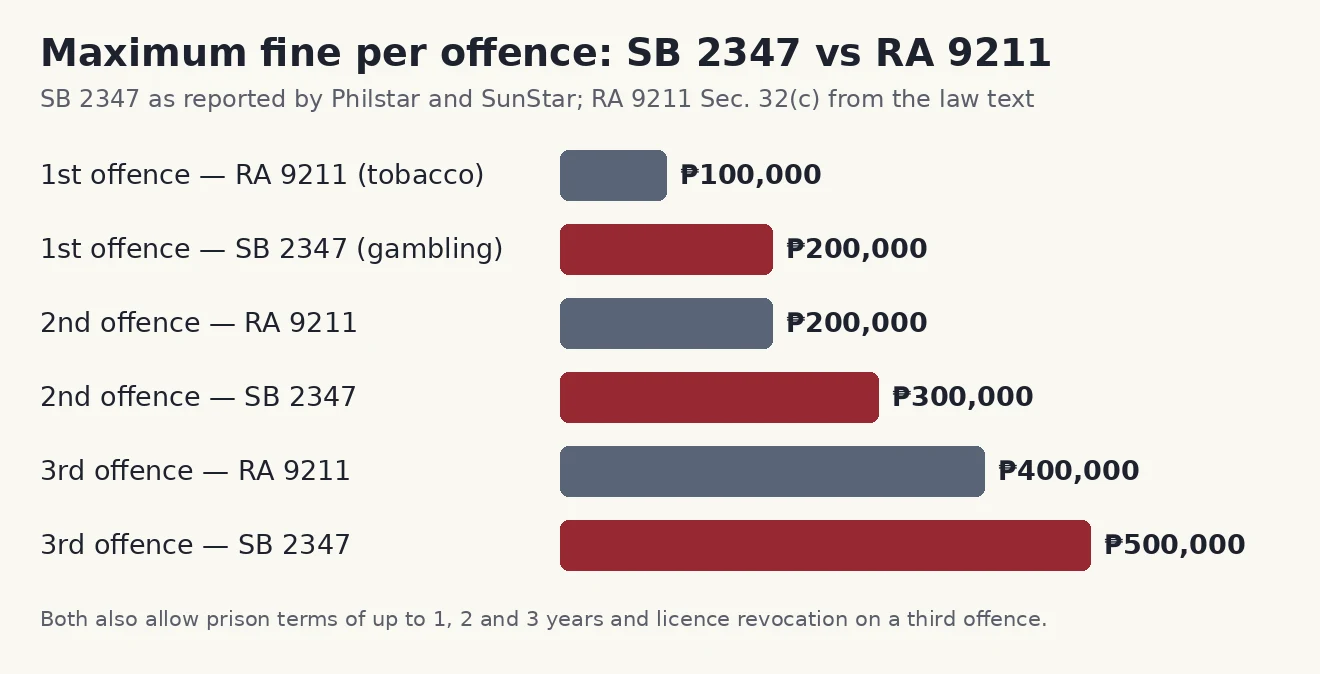
By our calculation, the proposed first-offence fine is 2 times the tobacco law’s, the second-offence fine is 1.5 times, and the third is 1.25 times. The prison terms are the same. The bigger difference is timing: RA 9211 gave the tobacco industry roughly three and a half to five years between 2003 and the final 2008 stage, while SB 2347, as reported, allows one year.
How big are those fines next to the industry?
PAGCOR’s own figures put the scale of the industry in perspective. In its 16 April 2026 release, PAGCOR reported gross gaming revenue (GGR) of ₱396.14 billion in 2025, up 6.39% from ₱372.33 billion, with the e-games and online segment contributing ₱201.12 billion, or 50.77% of the total. (Philstar quotes the 2025 figure as ₱396.13 billion; we use PAGCOR’s number.)
Our calculation: ₱396.14 billion spread over 365 days is about ₱1.09 billion of GGR per day. The highest proposed fine, ₱500,000, equals roughly 0.05% of one day’s industry GGR. For a large operator, the fine itself is small. The real deterrents in the bill are the prison terms for responsible officers and, above all, the revocation of business permits and operating licences on a third offence. A licence is worth far more than any single fine.
What would change for players, and what would not?
If the bill became law in the reported form, the visible changes would be in advertising: no gambling spots on TV and radio, no sponsored posts by celebrities or influencers, and no gambling sponsorships. Players would still be able to play on licensed platforms; the bill, as reported, regulates promotion, not the games themselves.
One side effect is worth thinking about. Advertising is one of the ways players learn which brands exist. A ban could make it harder for licensed operators to stand out from illegal ones, so verifying a platform’s licence becomes even more important. PAGCOR has said it is working on an app to help players identify licensed sites; until such a tool is live, check PAGCOR’s own published lists rather than relying on promotional material.
Other proposals moving in parallel
- House Bill 8114, filed by Representative Christopherson “Coco” M. Yap and stamped received on 26 February 2026, would prohibit the use of e-wallets, e-money, payment gateways and online banking transfers as payment channels for online gambling (bill text, House of Representatives).
- SunStar reports that Cebu City is considering a local ordinance banning gambling ads, which the City Legal Office supported on 20 July 2026 subject to revisions.
These are separate measures. Each must pass its own process, and none of them is law at the time of writing.
How far is SB 2347 from becoming law?
Filing is the first step of a long path. Under Article VI of the 1987 Constitution, a bill must pass three readings on separate days in each chamber, with printed copies of its final form distributed to members three days before passage unless the President certifies it as urgent. Once both chambers pass the same text, the bill goes to the President, who may sign or veto it. If the President does not communicate a veto within thirty days of receiving it, the bill becomes law as if signed.
In practice, the Senate bill would also need a House counterpart, committee hearings and, if the two versions differ, reconciliation. Only after enactment would the reported one-year transition begin. So even on a fast track, the earliest date on which the full ban could bite is well over a year away. Our reading: be sceptical of any claim that “gambling ads are now banned” unless it cites an enacted Republic Act number.
A worked timeline (illustrative, our assumption)
Suppose, purely for illustration, that the bill were enacted on 1 July 2027. With the reported one-year transition, operators would have until about 1 July 2028 to remove existing materials, and the penalty ladder would apply to violations after that date. The 2027 date is our assumption, not a forecast; no hearing or vote has been verified.
What is not confirmed yet?
- The full bill text and committee referral: the Senate’s legislative information pages returned a block or maintenance page when we tried them on 22 October 2026. The provisions above are therefore as reported by Philstar and SunStar.
- Exact filing date: both reports were published on 2 August 2026; we did not confirm the filing date from a Senate record.
- Whether the ban covers PAGCOR’s own promotions or responsible-gaming messages: not stated in the reports we read.
- Timeline: no hearing schedule has been verified.
Where this leaves you
Nothing changes for players today. If SB 2347 advances, expect fewer gambling messages in your feeds within about a year of enactment, and rely more on official licence checks than on ads. Online gaming in the Philippines remains restricted to adults aged 21 and over; set a budget, keep sessions short, and step away if it stops being fun.
Sources (checked 22 October 2026): The Philippine Star, 2 August 2026; SunStar, 2 August 2026; RA 9211 text (Lawphil); PAGCOR, 16 April 2026; House Bill 8114. Ratios, the per-day GGR figure and the fine-to-GGR share are our own calculation.