
Slot cascade history: five cleared symbols and three refilled symbols are not eight together
Published — UTC

A cascade replaces part of a grid. Symbols that have been removed no longer belong to the next state. Adding the earlier winning group to a smaller refill group can manufacture a combination that never existed on one grid.
Five removed, three new
Assume an invented rule pays a connected group of at least five A symbols. State 1 has one group of five; it qualifies and is cleared. After refill, state 2 has a separate group of three A symbols and no other A.
| Grid state | A symbols currently present | Threshold test |
|---|---|---|
| Before clear | 5 in one group | Passes |
| After refill | 3 in one group | Fails |
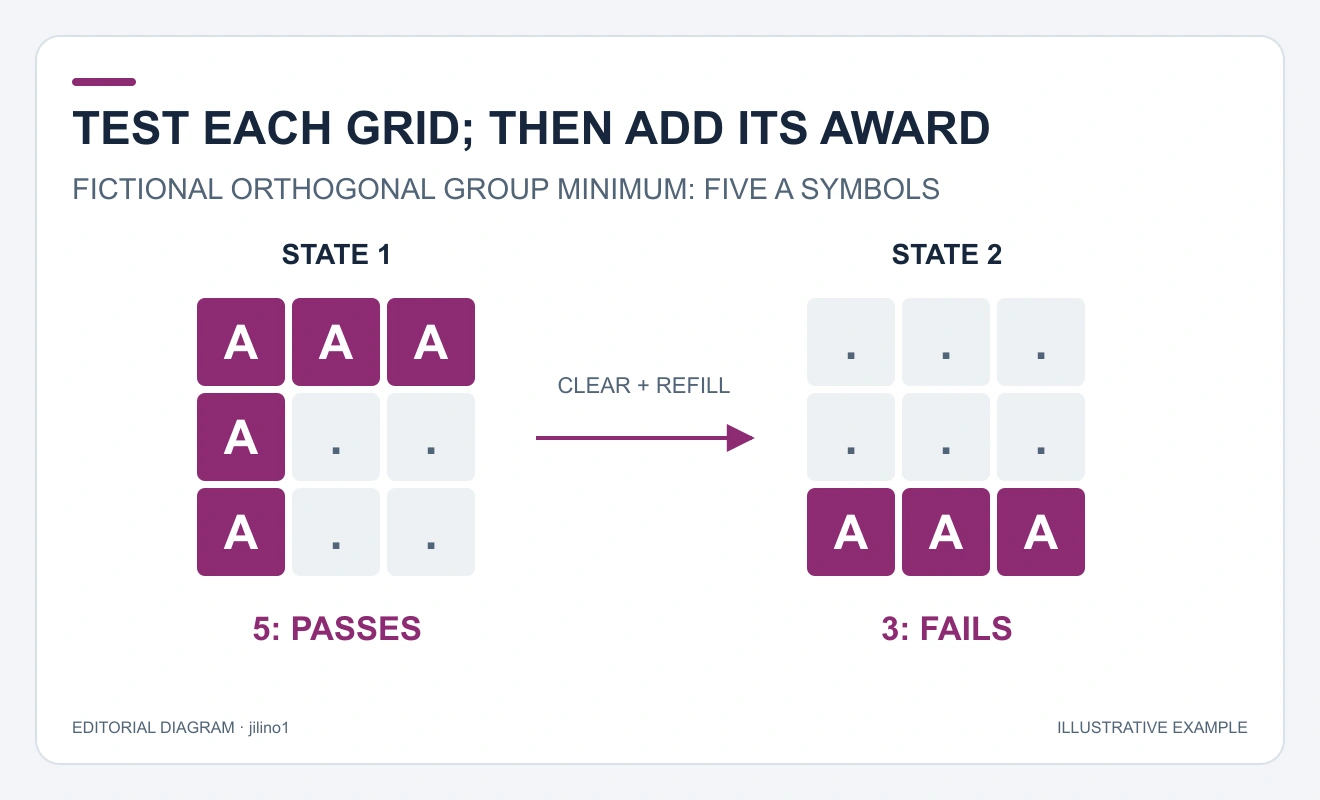
Five plus three equals eight appearances across time. It is not an eight-symbol cluster on the current grid. The earlier award may remain in the round total, while its cleared symbols do not remain in the next cluster.
Persistence needs an explicit rule
A special symbol or marked position might persist in a real feature. That exception needs its own documented state rule. A previous screenshot cannot prove persistence, and a running award total cannot tell which symbols survived.
The British result-determination reference concerns outcomes being determined under stated game rules. It does not describe this fictional cluster or a local edition.
Record the transition
Keep the round ID, cascade index, cleared positions, retained positions and post-refill group. That sequence makes both the earlier award and the current failed threshold understandable without counting removed symbols twice.
Coordinates make the state boundary visible
In a small fictional three-by-three grid, state 1 has A at (1,1), (1,2), (1,3), (2,1) and (3,1), using row then column. They form one orthogonally connected L of five. After clearing, state 2 has A only at (3,1), (3,2) and (3,3). These are three new appearances. Reusing coordinate (3,1) does not mean its old symbol survived; the transition record says the old one was cleared.
The award ledger follows a different accumulation rule
Assume, solely for the worksheet, that the first qualifying group returns 4 units and the second returns zero. The running award remains 4 after state 2. If the accepted round cost was 2, the currently accounted net is 2, provided the round is settled and nothing else applies. Keeping the earlier four-unit award is valid; keeping its removed symbols in the next threshold test is not.
What an explicit persistent symbol would change
Consider a different feature where a documented rule retains two qualifying symbols and the refill adds three connected to them. That current grid can contain five and satisfy the stated threshold. If the same five are split into disconnected groups under the same adjacency rule, total count five alone is insufficient. Both persistence and connection need evidence; neither follows from the earlier award total.
Compare ordered states, not selected frames
Store cascade indices, the clear mask, retained coordinates, refill and group membership. A screen captured between clear and refill is an intermediate animation, not necessarily the final evaluable grid. If one transition is missing, label it missing instead of reconstructing it from the final award. This keeps the sequence reproducible without assuming how a real edition handles special symbols.